Today we continue our series in preparation of my upcoming performance of Eric Ewazen’s “Concerto for Marimba and String Orchestra”. We look at some technical issues one must overcome to perform this work. How do you handle the technical aspects discussed in this episode? Leave your comments below the video or in the comments below.
New to the series? Check out Part I before watching.
Originally posted on DrummChattr.com on January 30, 2012 by Thomas Burritt.
This is a very cool phase-based piece performed by David Cossin of Talujon. Performed live, the player has a video of himself projected behind the live performance. You can both see and hear the phases, and additionally which of us doesn’t wish we had 4 arms every now and then.
(And for those of you who think “OK, I get it after the first few phases, do yourself a favor and watch the whole thing. Additional material is introduced after a full cycle of the original material.)
Originally posted on DrummChattr.com on January 28, 2012.
Today’s guest post comes from Matthew Raynor and his new percussion blog drumsimple. Matt is currently an instructor at Palmetto Percussion, a World Class indoor drumline and writes about his experiences and teaching on his blog. Although this post was written from a drum corp/indoor line perspective, I think these tips would be great for any ensemble. As always, we encourage your to leave you comments below. You can follow Matt on Twitter.
5 Simple Instructional Tips That Will Give You Immediate Results
By Matthew Raynor
I am always looking for results as an instructor. Whenever I finish with an individual lesson, a sub-sectional, or an ensemble I am always tracking progress of the student(s). Even in the middle of rehearsals, I am taking note of the immediate effect of my comments. Did the student improve? What contributed to the improvement? These questions are constantly floating around in my head.
Over time, patterns emerged and I began to see improvement in my students at a quicker pace. I also began to see their spirits rise and them enjoying drumming more. It’s hard to see or hear improvement in your playing from day to day. You could look at your first video/recording of the year and compare it with your final performance of the year and the difference would be drastic. You know that feeling when you see how far you’ve come as an individual or as part of a group?
It’s a great feeling! It makes you want to get out there and practice some more!!
Now, if you can lead your students to drastic improvement from day to day AND they are aware of it, you’ll be creating a self-perpetuating machine for improvement. Students will be motivated to get better when they show up to rehearsals and you’ll be more eager to see how far you can take your ensemble.
These tips are simple enough to include in your next rehearsal. Try just using one of them and make note of the results you get.
The Tips
Give comments that students can act on. Do not give comments that have no actionable element to them. An example I hear all too often is, “Guys, that wasn’t good. Do it again.” Where’s the instruction? Don’t be a critic. Be a leader and a teacher. Something as simple as “Drive your feet.” or “Loosen up your right shoulder to create more sound.” Those are comments on which a student can act.
Comment when you hear something played well, not always when phrases are played poorly. Just like your parents teach you right from wrong as a child, you are teaching the difference between playing well and playing poorly. Students are told all to often when they play something wrong. Give them some confidence. Stop them in the middle of something they’re playing really well. I do this and always ask, “Did you hear that?” Puzzled, they usually can’t answer. “That was really good!” I tell them what they played well, why it was good, and solidify what it feels and sounds like to play well. Try it.
Use affirmative language more than negative. This is simply the word choice you use to give comments. Instead of don’t use do. It helps keep students positively engaged and rehearsal light, instead of students getting down on themselves. Instead of kids thinking about what they aren’t supposed to do, and becoming self-fulfilling prophecies, they can think about how the music should be played correctly. There are so many ways to play a piece of music poorly. Can you think of every way to play poorly and guard against doing such? I know I can’t!
Be brave enough to change things up on a more regular basis. Let students be comfortable with change, even if sometimes it is drastic, to create the results you want. For example, when students are getting bogged down in a part of music we’re rehearsing I stop them, tell them 8-on-a-hand, and tap off in a new tempo. After finishing, we dive back into the part we were rehearsing and I find 99% of the time it is magically better. You interrupt the students’ pattern of thought and force them to play differently.
Give comments but leave out the reason why. Otherwise, you can fill the students’ heads with meta knowledge they don’t need to play well. More often than not, the student wants clear, concise, effective advise that will help them play better. They do not need the details as to why it is making them better. Is this always the case? No. There will be times when going deeper into a topic will help, but as a rule of thumb I try to stick to actionable comments without explanation.
These are 5 of the best ways I’ve been able to get drastically improved results out of groups that I teach on a regular basis and that I have stepped in front of for the first time.
I think some involved discussion about this topic would be beneficial to both students and instructors. Getting the perspective of not only the instructor but the student will provide a deeper understanding of what students are looking for and notice the most nowadays.
Let me know what you think below. I removed the need to include your email to comment. I hope this might encourage some to contribute.
Thanks for reading and good luck to any WGI groups embarking on their first show this weekend!
I’ve been busy this week getting Broadway Across America’s Wicked up and running for a 3 week Austin tour. Those of you who have played it know the challenges at hand. So significant, in fact, that the Percussive Arts Society Rhythm! Discover Center museum has dedicated a portion of an exhibit with pictures and set up maps.
In other ways of using technology to learn from each other there is an informative Facebook group page entitled Wicked Percussionists. And, of course, two episodes of Percussion Axiom TV dedicated to issues involved of my original run of the show in 2009.
What resources can you recommend to readers that can help someone else prepare for a gig? Leave your thoughts in the comments.
Originally posted on DrummChattr.com on January 26, 2012 by Thomas Burritt.
For some marimbists, especially intermediate players, a roadblock to certain repertoire is the widely utilized technique of the one-handed roll. In this brief video, well known composer and player Casey Cangelosi addresses how he develops his one-handed roll technique. What exercises did you use to develop your one-handed rolls? What did you find helpful in learning this process?
Originally posted on DrummChattr.com on January 25, 2012.
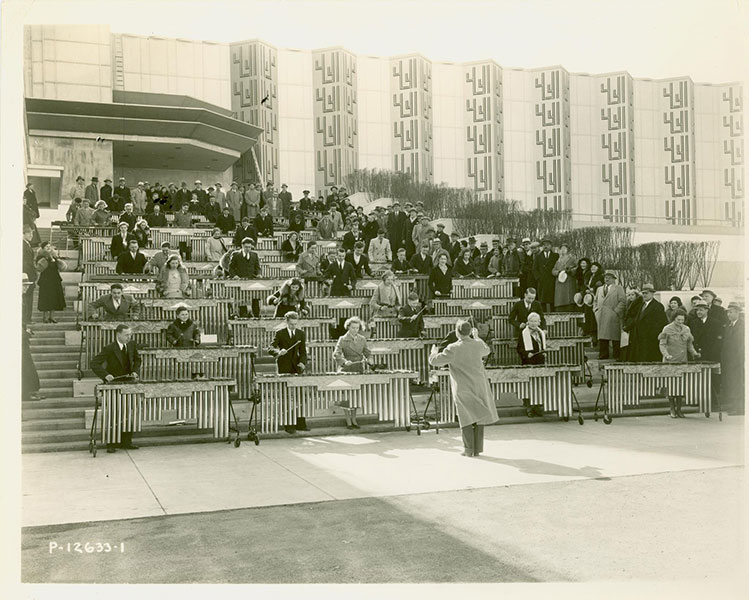
Today’s post comes from our friends at Steve Weiss Music. Recently, Steve has began collecting some of the Deagan instruments that were used in the Marimba Orchestra. According to The Deagan Resource, there were a 103 marimbas and one xylophone built for the event.
Here’s were you can help! Steve is trying to put together a list of the 100 players who participated in the Marimba Orchestra. To best of our knowledge, this list is missing and we would like to help Steve collect this information. Please leave a comment below with any information you may have about the Marimba Orchestra.
Here’s the original post from Steve Weiss’s Website.
The 1933-1934 World’s Fair was held in Chicago and is known as ‘A Century of Progress International Exposition’. Clair Omar Musser organized a 100 piece Marimba Orchestra for the fair. Deagan produced 100 specially made marimbas for the performances, each marked with a plaque on the front with the player’s name and serial number. To be part of the orchestra, each player needed to purchase the instrument that they would perform on.
Steve Weiss has become very interested in the marimba orchestra, and has started to collect the original marimbas as well as any information regarding the performances. The names of all original player’s appears to have been lost by history. The goal of this project is to research and publish the names of all 100 original players for the benefit of the percussion community.
A Century of Progress Marimba Orchestra Members
Clair Omar Musser (Conductor and Soloist)
Jimmy (James) Namaro (Assistant Conductor)
Frank Bailey (Serial 44)
Lewis Wadsworth Gallagher (Serial 70)
George Hamilton Green
Leona Hubbard
Eddy Kozak
Lorraine Adeline Krause
Ruth Stuber Jeanne
Evelyn Marion Neal
Velma Arlene Sandt
Kathryn Schmitz
Russell Terry Simmons (Serial 4A)
Rudolph Robert Willmann (Serial 55)
Rose Mae Wise (Serial 73)
Chicago Tribune, Aug. 20, 1933
An unusual musical organization is now appearing nightly in the court of the Hall of Science. It is a marimba band of 100 pieces directed by Clair Omar Musser.
The marimba has an interesting history. Apparently it is one of the oldest musical instruments. There are records indicating it existed, naturally in a much cruder form, as long ago as 2000 B.C. In its modern form it becomes a tricky affair, a matter of careful workmanship, of tuning by mathematical devices that not only give the proper pitch to the fundamental tones but to their overtones, partials, harmonics as well.
The present band began its enrollment on Jan. 1, 1932. From the start it was planned as a feature of A Century of Progress, but not until now has it been able to appear in public. Several numbers have been specially composed for the organization, and all the others appear as special arrangements. Its membership is cosmopolitan to a high degree. One of the players, Kathryn Schmitz, comes from Berlin, Germany; another, Jimmy Namaro, is a native of London, England; George Hamilton Green comes from New York, Lorraine Adeline Krause from Washington, D.C.; Leona Hubbard from California. Some thirty other states are represented in the membership.
Chicago Tribune, Edward Moore, Aug 22, 1933
An uncommonly entertaining musical organization is playing nightly in the court of the Hall of Science at A Century of Progress this week. It is a marimba band of one hundred pieces directed by Clair Omar Musser, and in many ways it is the most interesting group of music makers that has so far had any connection with A Century of Progress.
The marimba is one of the oldest musical instruments of which there is a record. Yet, this battery of one hundred, with their graduated, glistening resonating pipes, is startlingly in accord with modern ideas of line and mass. Not only that, but that have what will be to most people unexpected resources as makers of music.
As the marimbas are played under Mr. Musser’s direction, the have inspiring rhythm, they are capable of almost anything in spacious harmonic chords, they make melody in all ways from the snappy staccato to long sustained curves of melody, the have a wide range of expression, and an equally wide range of tonal quality. In other words, they are capable of playing a program in a highly persuasive fashion.
In the Pilgrim’s chorus, for instance, out of Wagner’s “Tannhauser” overture they produce a tone which for sheer loveliness you will hardly hear surpassed anywhere. It is like a group of ideal French horns ideally played, in fact better played than any other orchestra or band is able to play them. Mr. Musser leaves off conducting once in the program to turn to his own marimba and play a solo part in Thomas’ “Mignon” orchestra. He is a virtuoso of the instrument, playing it as Horowitz plays the piano or Heifetz the violin.
Elsewhere you will hear some music specifically written for the group, Rosales’ Bolero for one, which is not Ravel’s famous work of the same name, but a good piece just the same, also an arrangement of a suite from “Carmen,” also made with the organization in mind. The concerts are drawing enormous crowds, just as always happens when something musically attractive goes on at A Century of Progress. They are confidently recommended.
Who doesn’t love a beautiful marimba solo on a Monday? Blake Tyson’s A Cricket Sang and Set the Sun certainly fits the bill. Enjoy and let us know what pieces you would put in this category. Leave your thoughts below in the comments.
Originally posted on DrummChattr.com on January 23, 2012.
Today’s video features a beautiful vibraphone solo by Kyle Gann called Olana performed by Brad Meyer. Kyle Gann is a composer and was new-music critic for the Village Voice from 1986 to 2005. Since 1997 he has taught music theory, history, and composition at Bard College. This piece, as well as many of his other compositions, are available for free on his website.
As many of you know yesterday was SOPA/PIPA (Stop Online Piracy Act/Protect IP Act) internet Blackout Day. All across the web significant websites, (Google and Wikipedia to name just a few) in various ways, protested against these anti-piracy bills by going black or offering specific instructions on how visitors can protest.
No one is questioning that stealing and pirating digital content is wrong, however, it is clear that our politicians have no real working knowledge of how the web works. These bills, if passed, could very easily take Drumchattr down WITHOUT due process. One photo, link, or background song in a video would be all it would take for the content companies to shut us down.
So what about a compromise? How do we stop online piracy without breaking the internet? Before I would be willing to support a compromise, I would want specific proof that piracy actually hurts the large content creators. There is no such proof because the nature of the web disallows the gathering of such information. I attest that no effort to curb piracy by any government will be successful as pirates will always find a work around. Has anyone been able to fix “spam”?
WordPress, which went dark yesterday in protest, is the very platform that this NEW BUSINESS is built upon. Imagine what would happen to the blogosphere if these bills pass and WordPress.org gets censored.
In a stunning result, over 7 Million people signed a petition against these bills through Googles site alone. In one day, as a direct action to the extreme protests online, 13 congress representatives switched their stance from pro SOPA to anti SOPA, causing serious doubt that the bills will pass. While this is good news, it isn’t over yet. The large content creating industries in Hollywood will continue to push this forward. So, we must continue to act.
Please consider joining the ground swell by signing the petition, telling congress no it SOPA/PIPA. In the meantime check out these two videos, the above and below. They show great explanations of what is really at stake.
While this post features no drum or percussion content these issues are so important we felt the need to get the word out to our valued readers. Thanks for reading and for your continued support.
This year’s PASIC was one that was very special to me. I was unable to go last year for a few reasons, some financial, and some scheduling. Although I was not able to attend for the whole weekend, i could tell that this year i really needed to go. It seemed as though half way through my Junior year, it was time to Recharge my batteries, regain some inspiration, and most of all have a great time. Fortunate to have two great friends also attending from the studio at WCSU, we were able to plan flights appropriately, and split the hotel cost.
The first night was incredible, seeing Steve Schick perform as well as So Percussion was an amazing experience. After a long day of traveling we went back to our hotel the “La Quinta” (Very affordable Place to stay next time its in Indy) and crashed. The next day was exciting, two great drum set clinics, Billy Martin’s “Life on Drums” clinic, and John Riley’s clinic, “The Art of Improvisation.” Both Clinics were fantastic, and i recommend both artists books if you haven’t checked them out yet. Billy’s book interestingly enough, is in non western notation, its pretty cool.
Before both of these clinics, something amazing happened. Me and my roommate Matt, after spending a few hours in the showroom, were sitting outside of one of the clinic rooms looking over some music we had purchased. While waiting for doors to open, a man came up to us both and asked if we would mind if he sat with us. We of course said it was okay, and he proceeded to sit and talk drums with us. This is one of my favorite parts of PASIC. Tons of drummers and percussionist congregating together simply because they love playing, teaching and learning. As he sat down, we began talking. He had never really been exposed to Billy Martin. A big fan, i began telling him about his new DVD and book. After i told him about this he asked if i would be at the John Riley clinic happening later that day. I told him that i would definitely be there, and that I hadn’t had a lot of exposure to John Riley, but had heard a ton of great things. After this, he asked me if i would watch his things for a moment and i told him no problem. He literally went sprinting off. Some time passed, and as soon as i looked at my watch wondering where he had gone, he returned. He had Both of John Rileys books, “The Art of Bop Drumming” and “Beyond Bop Drumming” in his hands. He handed them to me and said, “You’d better check these out.”
It all happened so fast that when i looked down for a moment to look at the books, he was already on his way into Billy Martins clinic which was just starting. I yelled Thank you and he gave me a thumbs up. I quickly got up and grabbed my things to tell him again how thankful i was. When i entered the room, there were already so many people inside that i had lost him. Determined, i looked around for a while before i gave up and the clinic was officially starting. Amazed at this experience, i must have told everyone i knew that day about this incredibly generous man i had met.
The next day while browsing the Malletech Booth i recognized him and was able to finally shake his hand and formally thank him. John Riley was at the Alfred Booth later that day and was also able to sign both books for me. Having a terrible memory, today i cannot remember this kind mans name, although i want to remind everyone in the Percussion world how fortunate we are to have events like PASIC to bring us all together as a community. Experiences like the one i had are ones that make the world of percussion unique.
If the man who did this for me happens to read this by any chance, I want him to know how much his kind gesture touched me. Also, that I’ve been tearing apart “The Art of Bop Drumming” ever since i got back from Indy 😉
This is a very inspiring story and speaks well of the experience that is PASIC. Do you have similar stories about your experiences? Leave them below the post.
Originally posted on DrummChattr.com on January 16, 2012.